
Macro Stack #3 !
SET, SHARP and more!

Welcome Back to The MI Macro Stack!
In our first two posts, we described a little about “Motivational Interviewing” (MI), some challenges and responses to a traditional MI approach, what we mean by “Macro MI,” and how Macro MI may be helpful in serving others as they navigate change.
Here, we offer a (very, very) brief overview of socially engineered trauma (SET), the “SHARP” framework, key interventions in Macro MI, what it may mean to be structurally competent and an example contrasting a traditional approach with a Macro MI informed approach. Next time, we will offer considerations around broaching.
What is “SET?”
Macro MI asks us to facilitate change conversations that include a clear awareness that people experience Socially Engineered Trauma (SET). SET is the non-random distribution of trauma exposure within an unequal society. Membership within a marginalized identity group increases one’s likelihood of exposure to certain forms of trauma. Multiple and intersecting marginalized identities (such as race, gender, sexual orientation, economic class, religious affiliation, disability status, immigration status, etc.) amplify possibilities for SET exposure. Vulnerabilities to SET are caused by the force of societal marginalization rather than there being something inherently vulnerable about specific identities. (1)
For example, data around unhoused persons reveal that these community members’ experience is both traumatic in itself AND can increase their risk of exposure to other forms of trauma, injury and poor health outcomes. Unhoused street dwellers in the United States, for example, encounter forms of trauma experienced almost exclusively by those with low or no income. We can consider these traumas socially engineered as the prevailing neoliberal economic model fails to ensure universal access to many things including safe, affordable housing. (2)
Socially engineered traumas may appear benign in origin. On the surface, SETs may arise from sensible local and state bureaucratic regulations with facially neutral or even positive legislative intents, though with differential and catastrophic impact on marginalized community members. For example, parking ordinances may be intended to keep streets clear for cleaning or to enhance business and home access yet have utterly disastrous consequences for vehicle residents. (3)
What is the SHARP framework?
As Avruch and Shaia describe, SHARP is a model that integrates discussion of structural oppression, historical context, analysis of the helper’s role, reciprocity and mutuality between the person and helper, and power into the intervention in explicit ways. (4)
Further, structural oppression considers the issues in the person’s physical and social environment, outside their control, that impact the person and their ability to be successful. Historical context considers the historical events impacting the person’s environment, community and/or family that might be relevant to the issues they are experiencing in the present moment. Analysis of role considers the helper’s role in the specific service relationship, particularly as maintainer or disrupter of the status quo. Reciprocity and mutuality consider the strengths and gifts the person can share with the helper and with their own community. Power considers what the person can do, alone and/or with others, to change the ongoing impact of historical and structural oppression.
What are some of the key interventions of Macro MI?
Drawing and expanding from traditional MI, Macro MI relies on key interventions that include accurate empathy, contextualizing or normalizing, broaching, exchanging information in a collaborative and autonomy supportive way, offering feedback, focusing on change, and working with ambivalence (whether from the person and/or the helper). Person-centered communication skills like open questions, affirmations, reflections and summaries (OARS) are surely involved. We may use these selectively and differentially--or even in contrast to traditional MI--in the macro context. MI tasks or processes (engaging, focusing, evoking and planning) are flexed for space and grace into the macro conversation. Subsequent posts will explore key interventions and skill use within the macro context.
What are some of the benefits of serving someone from a Macro MI perspective?
Macro MI can help us access many benefits in serving others, and some follow here. First, we can reduce shame and blame the person might be experiencing. As a person understands and frames their so-called personal or individual level challenges in the context of broader systems of oppression and socially engineered traumas, they may place less personal blame on themselves (or on their immediate relationships). Instead, they may understand that the behaviors they engage in are a very logical response to the oppressive and traumatic systems in which they exist.
Second, we can provide a framework for engaging a person in systems-level change that may also directly support their individual level changes. Third, we can offer a way to distinguish between what MI traditionally considers sustain talk or discord with the very real and legitimate recognition that the systems within which the participant lives may not reliably support their individual health-related goals and/or may cause direct harm.
Fourth, we can support the person’s empowerment within oppressive systems--both by acknowledging their resilience without valorizing abuse, and by offering different ways to engage in change efforts. Fifth, we can support the person in community connection, linkage and engagement.
What may be key qualities of structural competency?
We can identify at least 5 attributes of structural competency for a Macro MI provider: a developed ability to recognize or identify structural influences on the shared change aim; an ongoing, progressively learned skill set; willingness toward benevolent action or mobilization; recognition of and engagement within human services as an inter- and multi-disciplinary endeavor; and an ongoing, developing understanding of historical discriminatory processes. (5)
Our Macro MI Collaborative is working on an “Inviting Structural Exploration” rating scale to guide helper practice. Our initial development processes reveal the significance of epistemic humility, expressed through genuine curiosity and interest, and setting aside one’s own perceived expertise in favor of guided mutual discovery. More about structural competency and this scale in future posts.
Finally, an example contrasting a traditional and macro approach:
Traditional approach:
Doris was referred by her oncologist to a tobacco cessation study. Evidence suggests that those receiving post-surgical cancer treatments are likely to experience improved health outcomes and quality of life through cutting back on or quitting tobacco products. Within the study, the participant can choose to work toward any wellness aim without a need to be exclusively focused on tobacco. The study staff facilitated a traditional motivational conversation and discovered that Doris was well aware of the benefits of cessation and the perils of continuing. She did have some strong reluctance to cutting back or stopping. Smoking helped her relax, get some peace and quiet in her difficult life, and maintain a way to socialize with work colleagues on breaks. Smoking had also helped her lose weight she had been advised to drop some years ago. She was concerned about maintaining her emotional balance during the stress of cancer treatment, as well as being able to say no to her work colleagues and to keep hunger at bay. She felt less than ready to address smoking decisions. She wanted to wait for some time, even to consider nicotine replacement therapy and gradually reduce her tobacco reliance. She mentioned she had much bigger things than smoking to worry about in the present. The study staff supported her autonomy and agreed with Doris to check back in a couple of months.
Macro approach:
When Doris mentioned she had much bigger things than smoking to worry about in the present, the provider ventured beyond the narrow study topics of tobacco cessation or wellness to show interest and curiosity about what might be going on. Doris said that she needed to skip a couple of weeks of study interviews anyway because she had to go to court. The provider wondered if Doris wanted to say more about that. Doris let the provider know that she had to attend the trial of the person charged with killing her son, and quitting smoking was off the table for a while due to her stress during this time. Doris and the provider both were well aware of the high incidence of gun violence in their community. The provider offered to talk with Doris about how these circumstances were impacting her. Beyond her obvious grief over losing her son in this way, Doris shared that she felt helpless to do anything—her grief was crushing, guns were ubiquitous, and part of her anger was around the slow emergency response time at her son’s shooting that resulted in a long delay for ambulance transport. She felt all alone and enraged, and that was part of her continuing commitment to the comfort smoking provided. The provider offered to look together with Doris into some community resources and connections. The provider was aware of a support group meeting for parents whose families were impacted by gun violence, as well as safer neighborhood groups and petitions for improving emergency response. The provider asked Doris which of any of these might be of interest to her—and for the time being there was no need to discuss smoking cessation. Doris met with the provider over another two scheduled study sessions. Doris chose to become involved in learning about structural barriers to emergency services suffered in neighborhoods like hers and joined an action group circulating petitions and mailing postcards. She also became active with the local parent group, whose members publicized their grief and demands for action in state and regional media. Doris’ increasing feelings of structural efficacy improved her overall well-being and contributed to change efforts she believed were vital. And she shortly discovered it was easy to stop smoking.
Please join us next time for a discussion of broaching!
For now—please enjoy some additional material:
Current Reading Suggestions:
Ibram X. Kendi (2026) Chain of Ideas: The Origins of Our Authoritarian Age
Art:
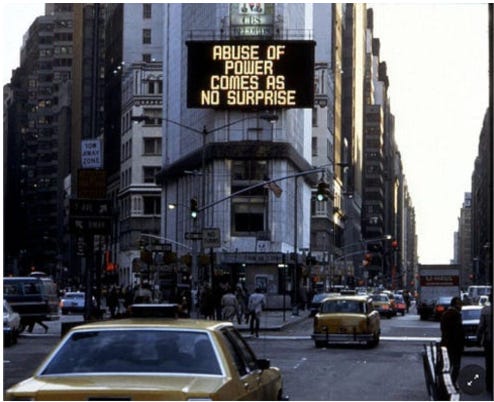
From Jenny Holzer’s “Truisms” (1978–87)
Song:
Eric Bibb---Change (2026)
Quotes:
“People have the right to call themselves whatever they like. That doesn’t bother me. It’s other people doing the calling that bothers me.”
Octavia E. Butler
“We must do what we can, there are no small efforts. Every positive effort is indeed meaningful.”
Patti Smith
“Power works by making it hard to challenge how power works.”
Sara Ahmed
Footnotes:
(1) SHARP: A Framework for Addressing the Contexts of Poverty and Oppression During Service Provision in the United States (Shaia, 2019) & Macro MI: Using Motivational Interviewing to Address Socially-engineered Trauma (Avruch & Shaia, 2022)
(2) Neoliberalism has been defined as an economic model that prioritizes fiscal austerity, privatization of public goods, financial and industrial deregulation, and the dismantling of public benefit and resource structures, in Spolander, G., Engelbrecht, L., Martin, L., Strydom, M., Pervova, I., Marjanen, P., Tassé, A., Sicora, A., & Adaikalam, F. (2014). The implications of neoliberalism for social work: Reflections from a six-country international research collaboration. International Social Work, 57(4), 301–312. https://doi.org/10.1177/0020872814524964
(3) Please see this fascinating interview with ethnoarchaeologist Graham Pruss: https://www.thesunmagazine.org/articles/25734-
(4) SHARP: A Framework for Addressing the Contexts of Poverty and Oppression During Service Provision in the United States (Shaia, 2019)
(5) Wilcox, Melanie & Pérez-Rojas, Andrés & Marks, Laura & Reynolds, Amy & Suh, Han Na & Flores, Lisa & McCubbin, Laurie & Wilkins, Kerrie & Miller, Matthew. (2024). Structural Competencies: Re-Grounding Counseling Psychology in Antiracist and Decolonial Praxis. The Counseling Psychologist. 52. 10.1177/00110000241231029; Mullane, J. (2023) Decolonizing Therapy, Norton. Melino K, Olson J, Hilario C. A Concept Analysis of Structural Competency. ANS Adv Nurs Sci. 2023 Apr-Jun 01;46(2):188-198. doi: 10.1097/ANS.0000000000000442. Epub 2022 Aug 27. PMID: 36036684; PMCID: PMC10153664; Dempsey, K, & Hall, A. (2026) Advancing Motivational Interviewing.