Macro Stack #4
Welcome back to the Macro Stack!

Broaching: The Bridge in Macro MI
Bring to mind a time when you broached a topic. What was the topic and with whom did you bring it up? Was it easy to talk about? Hard or painful? Was it as bad as you thought it would be? In what way? In what ways did you feel able—or not—to navigate any discomfort?
We ask for you to bring broaching to mind because broaching by definition is not easy. We don’t talk about broaching the topic of going to Disneyland with your children, unless of course, we are not going to make it to Disneyland this summer. Broaching – approaching (not avoiding) a topic and initiating (leading) the conversation by its nature is challenging to do.
Yet broaching is also necessary for most aspects of growth in our lives. We are doomed to shrink or stay frozen, or alternatively, act out of frustration, disappointment, inequities, and other difficult relational experiences if we never speak our mind and request or create awareness or change in the situation. Such a dynamic is true in the helping professions as it is in personal relationships, and we are aware of the importance of understanding how we are impacted by those we support and best practice states that we will bring up (broach) difficulties in individual communication and expectations.
In the individual session, we broach the dynamics that occur between provider and client frequently. Take for example the decision to bring up someone’s chronic lateness, “I am noticing you are here at least five often ten minutes late for our appointment, and I would like to explore that with you. There are reasons for your lateness, but I don’t know what they are, and I can better help you if we know and can talk about it.” The provider also responds to the ways in which the therapeutic conversation is unfolding… “I sensed when I brought up your decision to not talk to your parents, that you stepped back from the conversation. It’s been about five minutes since I brought that up and I sense it had an impact on you, and I wonder what that might be.” Many more examples can be provided about all the ways in which we broach relational dynamics in sessions: when discord emerges, when provider is experiencing and responding to countertransference, and when noticing communication patterns between clients in session. Helping professionals are trained to recognize and bring up these topics, and many professionals identify this practice as central to providing effective and competent care.
Broaching, however, can become more challenging and is more often avoided, when the topic moves into potentially sensitive and changed dynamics around power and privilege in the culture, starting with how it is manifesting between the practitioner and the client. Historically, differences have been avoided in the helping professions, and as a consequence it is unlikely that we received training or mentoring in broaching such differences. The decision of early psychoanalysts, particularly Freud, to move away from addressing the impact of political movements like communism and fascism on their analysands marked the first attempts to make mental health treatment non-political. This shift focused solely on the internal world of the patient, conceptualized around unconscious drives presumably uninfluenced by larger social and economic realities.. [1] The current political climate in the United States and other countries, characterized by rising conservatism and authoritarianism, makes it challenging to discuss the profound impact of half a millennium of colonization and other forms of autocracy on individual lives and communities. These historical events have left lasting social inequities, including socially engineered trauma, which can be socially, academically and occupationally uncomfortable—and even physically hazardous--to discuss.
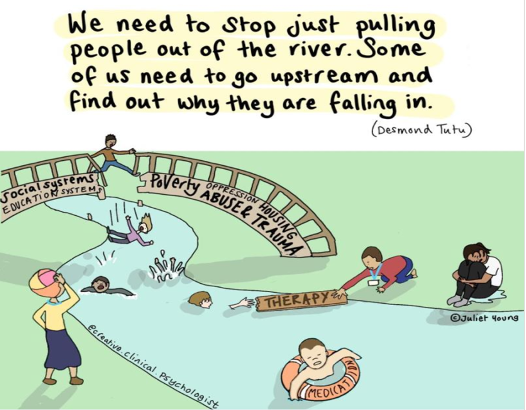
The nature of Macro Motivational Interviewing is to do exactly what historically has not been done and presently suppressed: address the social causes of inequities which in turn have been the drivers of individual and community trauma, loss, and illness. [2] Broaching the existence of such inequities and how they show up in the clinical work is core to understanding the root cause of an individual’s presenting concerns and how and if they are ready to change and grow.
Norma Day-Vines, researcher, counselor educator, and Associate Dean for Diversity and Faculty Development at Johns Hopkins School of Education, has offered practical leadership around broaching practice for almost two decades. According to Day-Vines, broaching issues around race and identity, more broadly, brings the sensitive conversations that might otherwise be avoided into the room where they can be addressed instead of ignored. Broaching functions as a bridge between provider knowledge about social justice issues and the practical application of this awareness in the clinical setting; having historical, contextual, and social knowledge is not of much use if it stays in the realm of abstraction and is not integrated into the helping conversation. Once cultural issues are integrated into the clinical conversation, broaching is of practical benefit to both the provider and the client. What was unstated but known, is now made transparent and accessible in the conversation.
Here too, broaching is difficult, as successful broaching depends on the helper’s comfort with the topic. A provider who holds the belief that that culture has no place in the clinical conversation will avoid the topic, whereas those who have a worldview based on the understanding of culture and its impacts on the individual and community, and have and continue to do their own self-exploration regarding their experience of culture, are more likely to broach cultural issues as they see such issues as central to the clinical conversation.[3] Broaching varies between these two extremes based on individuals (client and provider) and their contexts. Day-Vines does offer some guidelines on broaching via the Multidimensional Model of Broaching Behavior (MMBB), which is summarized here for space. We have added where MI skills (open-ended questions, affirmation, reflections and summaries) can be used to further build empathic connection and support our client’s autonomy:
1. Joining: Listening carefully how the person speaks about their own experiences – validate and affirm their perspectives and determine strengths and resources.
2. Assess: One’s own racial understanding and awareness, the client’s readiness to explore racial concerns and the strength of the therapeutic alliance. Complete a cultural formulation and address racial identity functioning and other intersectional identities (gender, sexual orientation, class, etc.)
3. Prepare: Determine the reason for broaching and choose a dimension to broach. Explore with open-ended questions, incorporate reflections on content and process, and affirm strengths: intracounseling – the differences between provider and client; intraindividual: addressing the client’s intersectional identities; within racial ethnic group issues/concerns; racial/ethnic concerns outside the group, including within oppressive systems. Label the types of oppression that emerge during the assessment.
4. Delivery: Bring up difference in identities, experiences, and privilege in the counseling relationship (consider open-ended questions); communicate using culturally-responsive communication (reflection); affirm client strengths; advocate for client’s needs; continue to build knowledge base regarding client’s cultures and experiences in the current community and political environment. [4]
Using these techniques is a way to effectively move into Macro MI practice. Current social sanctions on speaking truth to reality – being “woke,” the proliferation of diagnostic material online as well as the pressure to self-diagnose, and the cultural move to reframe inhumane practices as individual deficiencies, all result in increasing despair, hopelessness, and isolation. Courageously broaching individual identities that are otherwise left out of the conversation moves us down the path toward offering real avenues to change and growth based on truth, delivered with compassion.
Additional reading suggestions:
2020 article clarifying the links between the MMBB and social justice competencies for counselors
Seminal Document and the Multicultural & Social Justice Counseling Competencies
A poem: Dr. Jaiya John
A song: Ezra Collective (Only Love)
A quote: Henri Nouwen
“We who want to bring about change have first of all to learn to be changed by those whom we want to help.”
A photograph (self-portrait):
Graciela Iturbide, El Baño de Frida (Frida’s Bathroom), Coyoacán, Ciudad de México, 2005

In 2005, just over 50 years after Frida Kahlo’s death, Graciela Iturbide (b. 1942) was commissioned to photograph the contents of the artist’s bathroom at her home, Casa Azul, open to the public as the Frida Kahlo Museum. The room with 300 of Kahlo’s personal belongings had been locked for decades after Kahlo’s mourning husband, Diego Rivera, ordered the space sealed for 15 years following his own death. Iturbide’s self-portrait evokes Kahlo’s famous painting What the Water Gave Me (Lo que el agua me dio) (1938). In the image above, Iturbide rests her feet against the front of Kahlo’s bathtub, mimicking Kahlo’s painting of her own feet partially submerged in a tub, her right foot bleeding, a collage of surreal images floating in the bathwater. In this, Iturbide acknowledges Kahlo’s art historical precedence and the significance of this private space. Iturbide portrays her own suffering as well by revealing her pained feet after a recent operation, conveying their connected experiences across 5 decades.
[1] Gabarron-Garcia, F. (2025). A people’s history of psychoanalysis (S. Branson, Trans.). Pluto Press.
[2] Avruch, D. O., & Shaia, W. E. (2022). Macro MI: Using motivational interviewing to address socially-engineered trauma. Journal of Progressive Human Services, 33(2), 176–204. https://doi.org/10.1080/10428232.2022.2063622
[3] Day-Vines, N. L., Wood, S. M., Grothaus, T., Craigen, L., Holman, A., Dotson-Blake, K., & Douglass, M. J. (2007). Broaching the subjects of race, ethnicity, and culture during the counseling process. Journal of Counseling & Development, 85(4), 401–409. https://doi.org/10.1002/j.1556-6678.2007.tb00608.x
[4] Day‐Vines, N. L., Cluxton‐Keller, F., Agorsor, C., & Gubara, S. (2021). Strategies for Broaching the Subjects of Race, Ethnicity, and Culture. Journal of Counseling and Development, 99(3), 348–357. https://doi.org/10.1002/jcad.12380